Outputs of fMRIStroke
fMRIStroke outputs conform to the BIDS Derivatives specification (see BIDS Derivatives, along with the upcoming BEP 011 and BEP 012). fMRIStroke generates three broad classes of outcomes:
Visual QA (quality assessment) reports: one HTML per subject, that allows the user a visual assessment of the quality of preprocessing. If the output dir is the fmriprep dir then the fmriprep report will be updated with fmriStroke figures.
Derivatives (preprocessed data) the input fMRI data ready for analysis, i.e., after the various preparation procedures have been applied.
Confounds: Confounds signals that can be utilized to run subsequent denoising steps.
fMRIStroke can be either run run level, each run is preprocessed independently or session level with the tag --session-level. In the latter case,
preprocessed runs are concatenated and fMRIStroke pipeline is run on this new concatenated run (compcor regressors are computed for the new run).
Layout
Assuming fMRIStroke is invoked with:
fmristroke <input_dir>/ <output_dir>/ participant --fmriprep-dir <derivatives_dir> [OPTIONS]
The outputs will be a `BIDS Derivatives`_ dataset of the form:
<output_dir>/
  logs/
  sub-<label>/
  sub-<label>.html
  dataset_description.json
  .bidsignore
For each participant in the dataset,
a directory of derivatives (sub-<label>/)
and a visual report (sub-<label>.html) are generated.
dataset_description.json is the metadata file in which fMRIPrep
records metadata recommended by the BIDS standard.
Visual Reports
fMRIStroke outputs summary reports, written to <output dir>/sub-<subject_label>.html.
These reports make visual inspection of the results easy.
View a sample report.
Note
If the <output_dir> is the same as <fmirprep_dir> the fmriprep report will be updated with some visual report specific to lesions. Otherwise a report containing only lesion specific quality checks will be generated.
Coregistration
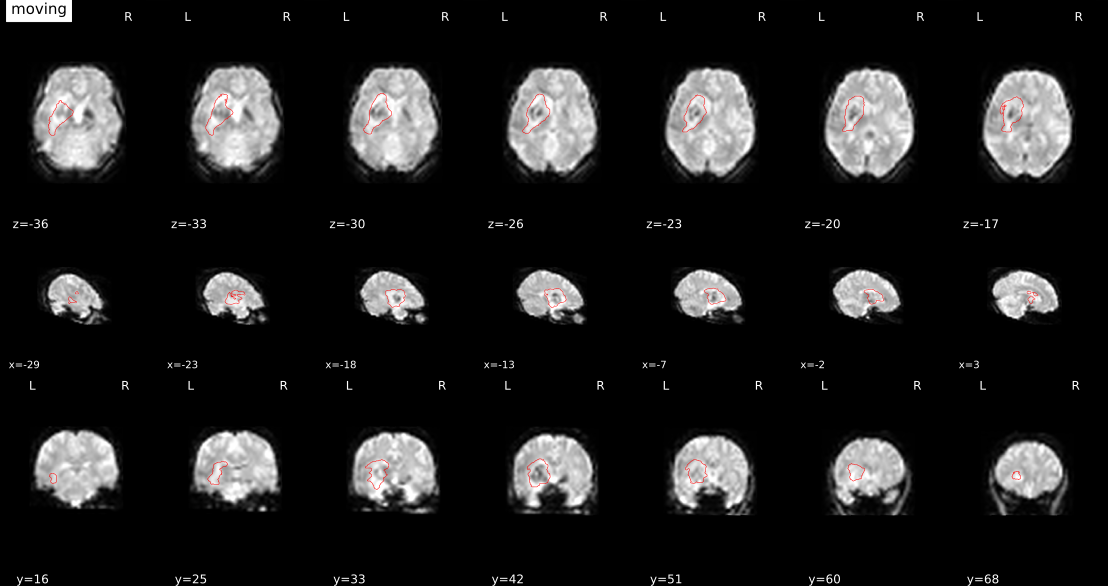
The ROI mask (in red) is added to the coregistration plot.
Hemodynamics
Stroke disrupts the brain’s vascular supply, not only within but also outside areas of infarction. [Siegel2016] investigated temporal delays (lag) in resting state functional magnetic resonance imaging signals and found that significant hemodynamic lag was observed in 30% of stroke patients sub-acutely and approximately 10% of patients showed lag at one-year post-stroke. Lags systematically alter measurements of fonctional connectivity from the affected nodes. Thus [Siegel2017] recommends excluding patients with an hemodynamic lag > 1s. Eiher way, lags should be kept in mind when doing FC analysis of stroke patients.
Hemodynamic lag is determined here using cross-correlation with the global gray matter signal. Visual report includes the lagmaps along with the max correlation map (Correlation corresponding to the lag in the lagmap).


Derivatives of fMRIStroke (preprocessed data)
Preprocessed, or derivative, data are written to
<output dir>/sub-<subject_label>/.
The `BIDS Derivatives`_ specification describes the naming and metadata conventions we follow.
Anatomical derivatives
Anatomical derivatives are placed in each subject’s anat subfolder:
sub-<subject_label>/
  anat/
    sub-<subject_label>[_space-<space_label>]_label-lesion_roi-.nii.gz
Spatially-standardized derivatives are denoted with a space label,
such as MNI152NLin2009cAsym, while derivatives in
the original T1w space omit the space- keyword.
Functional derivatives
Functional derivatives are stored in the func/ subfolder.
All derivatives contain task-<task_label> (mandatory) and run-<run_index> (optional), and
these will be indicated with [specifiers]:
sub-<subject_label>/
  func/
    sub-<subject_label>_[specifiers]_space-<space_label>_desc-lagmap.nii.gz
Regularly gridded outputs (images).
Volumetric output spaces labels (<space_label> above, and in the following) include
T1w and MNI152NLin2009cAsym (default).
Extracted confounding time series. For each BOLD run processed with fMRIStroke, an accompanying confounds file will be generated. Thi confound file, contains both fmriprep confounds and additional lesion specific confounds. Confounds are saved as a TSV file:
sub-<subject_label>/
  func/
    sub-<subject_label>_[specifiers]_desc-confounds_timeseries.tsv
    sub-<subject_label>_[specifiers]_desc-confounds_timeseries.json
These TSV tables look like the example below, where each row of the file corresponds to one time point found in the corresponding BOLD time series.
csf |
white_matter |
global_signal |
std_dvars dvars |
framewise_displacement |
|---|---|---|---|---|
682.75275 |
0.0 |
491.64752000000004 |
n/a |
n/a |
665.3969 |
0.0 |
488.03 |
1.085204 |
16.323903999999995 |
662.82715 |
0.0 |
487.37302 |
1.01591 |
15.281561 |
Confounds
The BOLD signal measured with fMRI is a mixture of fluctuations of both neuronal and non-neuronal origin. Neuronal signals are measured indirectly as changes in the local concentration of oxygenated hemoglobin. Non-neuronal fluctuations in fMRI data may appear as a result of motion, scanner noise, physiological fluctuations (related to cardiac or respiratory effects) but also lesion specific artefacts.
Confounds (or nuisance regressors) are variables representing these fluctuations with a potential non-neuronal origin. These non-neuronal fluctuations may drive spurious results in fMRI data analysis, especially in functional connectivity analyses. To minimize those confounding effects we can include them as nuisance regressors and regress them out from the fMRI data, also known as denoising. There is currently no consensus on an optimal denoising strategy in the fMRI community. Different strategies have been proposed, which achieve different compromises between how much of the non-neuronal fluctuations are effectively removed, and how much of neuronal fluctuations are damaged in the process. The fMRIPrep pipeline generates a large array of possible confounds and the fMRIStoke pipeline adds to these confounds some lesion specific ones refer to [Yourganov2017] for more details.
Danger
Similarly to fmriprep computed confounds:
Do not include all columns of ~_desc-confounds_timeseries.tsv table
into your design matrix or denoising procedure.
Filter the table first, to include only the confounds (or components thereof)
you want to remove from your fMRI signal.
The choice of confounding variables depends on the analysis you want to perform and the data you have,
it may be not straightforward as no gold standard procedure exists. fMRIStroke includes a denoising step in its pipeline
using simple strategies proposed in the litterature. However, it is up to you to either use these denoised BOLD series, add a custom strategy or
denoise using the ~_desc-confounds_timeseries.tsv output independently of fMRIStroke.
Confound regressors description
Refer to fmrirep doc for more details about confounds and confounds regression.
ICLesion confounds. ICLesion analysis is a ICA, based noise identification method. In the method, independant components are calculated on the bold signal and components that overlap with an ROI that is unlikely to include signal related to neuronal activity, such as Lesion masks are identified as potential noise component. Signals extracted from ICA components can be further regressed out from the fMRI data with a denoising procedure [Yourganov2017].
IC_lesion_XX- additional noise components are calculated using ICA;
Each confounds data file will also have a corresponding metadata file
(~desc-confounds.json).
Metadata files contain additional information about columns in the confounds TSV file:
{
  "ica_lesion_06": {
    "Method": "canICA",
    "Retained": true,
    "jaccard": 0.06,
}
For ICA decompositions, entries include:
Method: ICA method used.
Retained: Indicates whether the component was saved indesc-confounds_timeseries.tsvfor use in denoising.
Jaccard: Overlapping between spatial map of component and ROI mask.
Confounds on the visual reports
The visual reports provide several sections per task and run to aid designing a denoising strategy for subsequent analysis.
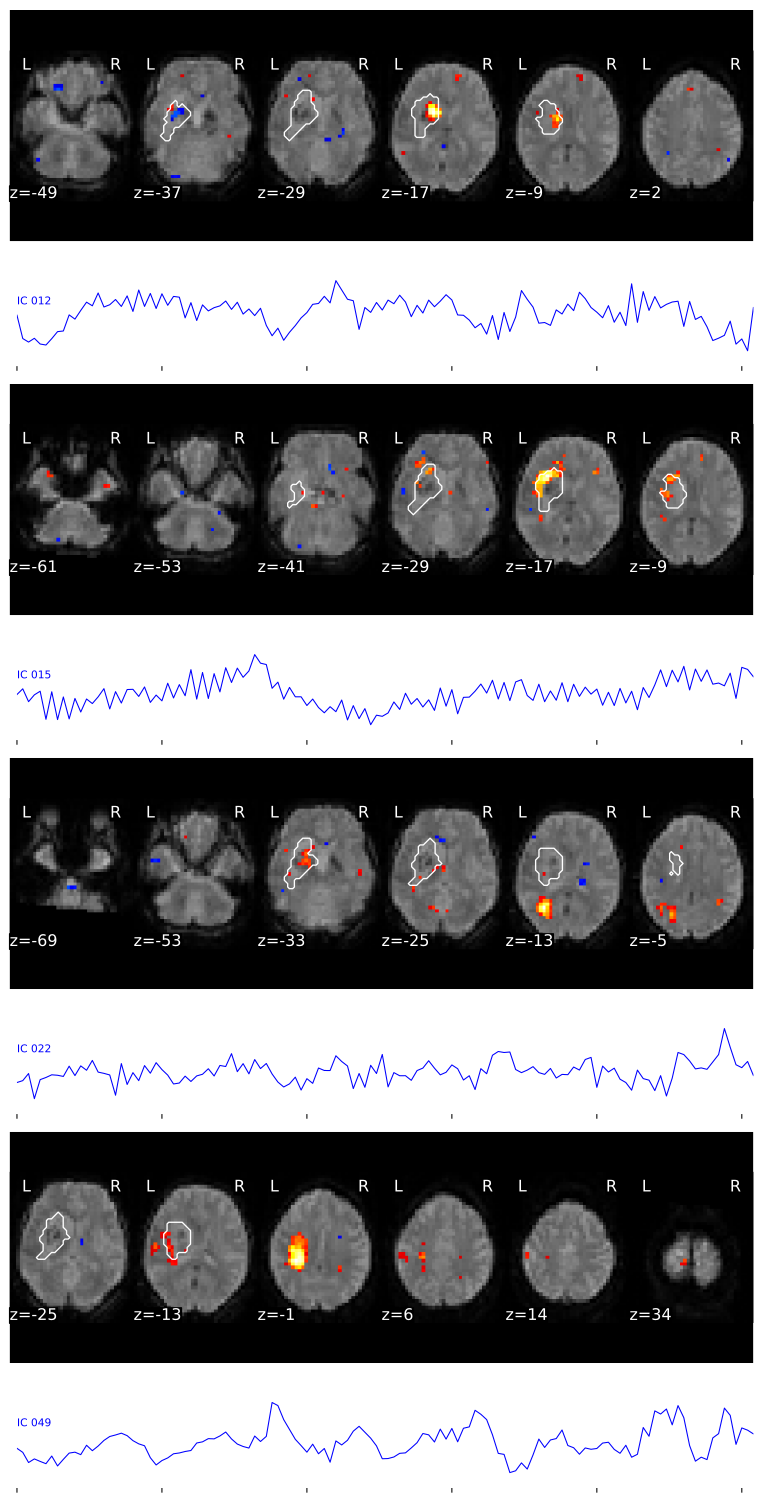
Noise components computed during ICA decomposition are evaluated according to the overlap of their spatial map with the ROI mask. This is used by fMRIStroke to determine whether each component should be saved for use in denoising operations: a component is saved if the jaccard index between ROI and binarized spatial map is > 5%. fMRIStroke reports include a plot of the spatial map of each included component along with associated signal.
Denoising
As mentioned above there is no concensus on denoising strategy. However, fmristroke proposes some simple denoising pipelines [Yourganov2017] to preprocess your data. By default fmristroke performs denoising using 4 different pipelines described below. Among those pipelines two are “basic” pipelines non specific to stroke patients (SimpleGS and CompCorGS), and two are lesion specific denoising pipelines. Each pipeline is defined as a single .json file.
Denoised BOLD series will be saved as:
sub-<subject_label>/
  func/
    sub-<subject_label>_[specifiers]_space-<space_label>_pipeline-[Pipeline]_desc-denoised_bold.nii.gz
SimpleGS
Denoising strategy based on regressing out: 24HMP - 24 head motion parameters including: 3 translations, 3 rotations, their temporal derivatives, and their quadratic terms, 8Phys - mean physiological signals from white matter (WM) and cerebrospinal fluid (CSF), their temporal derivatives, and quadratic terms, and high pass filtering by adding discrete cosines transformation basis regressors to handle low-frequency signal drifts.
CompCorGS
Denoising strategy based on regressing out: 24 head motion parameters including: 3 translations, 3 rotations, their temporal derivatives, and their quadratic terms, CompCor - Signals from CompCor, and high pass filtering by adding discrete cosines transformation basis regressors to handle low-frequency signal drifts.”,
SimpleLesionGS
Same as SimpleGS but with updating region signals (WM and CSF) with lesion mask.
ICLesionGS
Same as SimpleLesionGS but adding IC_Lesion signals. [Yourganov2017]
Adding custom strategy
You can easily add a custom pipeline by creating a .json file. A file should follow the structure below.
{
"pipeline": "Name",
"desc": "Denoising strategy based on ...",
"confounds": {
    "wm_csf": {
        "wm_csf": "full"
    },
    "global_signal": {"global_signal": "full"},
    "motion": {"motion": "full"},
    "high_pass": {}
},
"demean": true,
"clean_spec": {"detrend": true}
}
Denoising is run using nilearn, refer to nilearn doc (load_confounds) for list of possible confounds and corresponding arguments. To those you can add iclesion and wm_csf_lesion with argument wm_csf that can either be full, basic, power2, derivatives.
Connectivity
fmristroke also outputs connectivity matrices computed on the denoised bold, computed using your choice of atlases and connectivity measures. By default, the [Scheafer2018] atlas (with 400 ROIs ordered in the 17 Yeo Networks) is
used and the correlation is used to measure the functional connectivity. Multiple atlases can be used as well as multiple connectivity measures thanks to the tags --output-atlases and --conn-measure.
Connectivity matrices will be saved as:
sub-<subject_label>/
  func/
    sub-<subject_label>_[specifiers]_pipeline-[Pipeline]_atlas-[Atlas]_measure-[connectivity Measure]_desc-connectivity_mat.npy
Measures
Connectivity measurement is run using nilearn, refer to nilearn doc (ConnectivityMeasure) for the list of supported measures.
Atlas
You can easily add a custom atlas by creating a .json file. This file should follow the structure below.
{
"atlas": "Atlas name",
"labels": "<filename>.csv",
"space": "Space in which the atlas is defined",
"mask_file": "<filename>.nii.gz"
}
Note
The mask_file and labels files should be in the same directory as the json file.